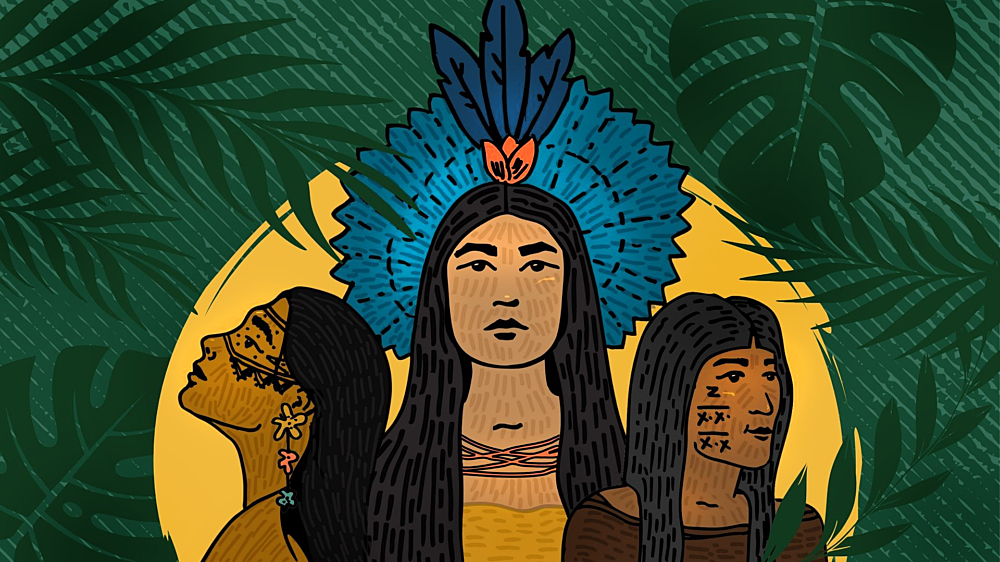

Illustration: Cindy Chischilly (Dine)/Nia Tero.
December 18, 2025
COP30: Wins and Disappointments from the ‘Indigenous Peoples’ Climate COP’
Interview by Luana Polinesio, Image by Cindy Chischilly (Dine)
Held in the Brazilian Amazon, COP30, the 30th Conference of the Parties of the U.N. Framework Convention on Climate Change drew a record number of Indigenous Peoples in November. The gathering brought together 56,000 participants, including approximately 5,000 Indigenous representatives from around the world, to address climate change.
Nia Tero focused on Indigenous Peoples’ participation by supporting gathering spaces like the Indigenous Caucus Pavilion, COP Village, Casa Maraká, and others. In addition, Nia Tero collaborated with several key partners to offer a seminar series to make COP30 easier to navigate for Indigenous participants.
One remarkable win for Indigenous rights and environmental protection during COP30 was the final recognition and demarcation of the Kaxuyana-Tunayana Indigenous Land and three other territories in Brazil, totaling nearly 2.5 million hectares of land secured for Indigenous Peoples. The impacts of this key announcement are profound: it means stronger biodiversity protection and climate stability in one of the most ecologically significant regions of the Amazon, and it also ensures legal protections and greater sovereignty for Indigenous Peoples.
Beyond the official negotiations, the renewed Forest and Land Tenure Pledge will provide US$1.8 billion to support Indigenous Peoples, local communities, and Afro-descendant communities in protecting their lands and forests. The commitment sends an important signal for the continued support of forest communities in the coming years, also serving as a pathway to increase funding for Indigenous Peoples.
In this interview, we hear from three women who helped lead Nia Tero’s efforts at COP30:
- Carmen Guerra (Kankuama, Colombia), Policy Manager, Nia Tero
- Valeree Nolasco, Global Policy Consultant, Nia Tero
- Nara Baré (Baré, Brazil), Brazil Director, Nia Tero
They discuss the vital role of Indigenous voices shaping the global response to climate change and the major outcomes of COP30 for Indigenous communities.
Q: What were Nia Tero’s goals at COP30?
Nolasco: The goal of Nia Tero at every COP is to support and facilitate Indigenous Peoples' ability to engage in global policy spaces. We have been conducting policy training sessions for years to prepare Indigenous Peoples to participate in negotiations. This year, we additionally offered a grant to support the Indigenous Peoples Pavilion in the Blue Zone, which served as a space for Indigenous Peoples to convene. We also collaborated with Indigenous communicators to amplify Indigenous Peoples’ messages through our comms work and channels.
Q: Carmen, you have been leading policy training sessions alongside Nia Tero’s partners with the aim of strengthening Indigenous Peoples' effective participation in global decision-making spaces, such as COP30. Why are these trainings important for Indigenous Peoples?
Guerra: Indigenous Peoples are at the forefront of caring for Mother Earth in their own territories. Therefore, it is essential to elevate their voices, not only for COP but also in other global spaces.
The training sessions stem from the recognition that Indigenous Peoples have solutions to offer. Each training is a joint effort designed to support Indigenous leaders and youth in having their voices and contributions heard as decision-makers, thereby equipping Indigenous Peoples with the tools for effective engagement in global policy spaces. In practice, the training sessions help them navigate the United Nations systems. For COP30, we had six sessions that took place ahead of the conference, and more than 2,000 people registered.
Q: COP30 had an impressive turnout of Indigenous Peoples. However, even with increased participation, they still don’t have direct access to the negotiations. How did their presence impact policy outcomes?
Nolasco: The high attendance of Indigenous Peoples occurred in part because Brazil, a country with an Indigenous Ministry, hosted the event, and because the COP was held in the Amazon. However, we must keep in mind that the primary purpose of the COP is for states to come together and discuss the commitments they made regarding climate change under the Paris Agreement. As it pertains to the actual negotiations, the rest of society observes but cannot participate in these negotiations. That said, it was a landmark opportunity for Indigenous Peoples to be present and to be heard during the event, as the COP presidency provided a considerable number of badges to enable their presence in the Blue Zone, even though this does not guarantee access to all the decision-making spaces.
In general, we can say that this COP has been the most inclusive for Indigenous Peoples. From a local perspective, many Indigenous groups hoped the COP would open broader avenues for direct engagement with the State, which didn't materialize in all of the ways that these groups had expected. At the same time, we acknowledge that the president of Brazil seized this opportunity to demonstrate a political will to make a significant decision for Indigenous Peoples, specifically regarding the demarcation of their territories. So, for me, it was a success in terms of participation.
Baré: Indigenous Peoples were present on several fronts, in the Blue Zone, Green Zone, COP Village, and others. I would like to highlight the special participation of Indigenous experts and scientists. Additionally, it's worth noting that it wasn't just Indigenous People who had a relevant role; civil society and the broader public were also present, showing that we can accomplish many things together. For me, this COP brought a message of significant collective advances, with everyone doing their part. This was a kind of wake-up call for governments that are deciding on a guiding document that many countries end up ignoring, and, as a consequence, the crisis intensifies. Civil society, Indigenous Peoples, and their supporters demonstrated that there are ways to advance towards a better and more just world.
Guerra: One thing is to “participate,” and this was visibly powerful at COP30 with the strong presence of Indigenous Peoples, especially from the Amazon and other regions, like South America, Central America, and the Caribbean. However, full participation is something fundamentally different: it is a rights-based standard, not merely a presence. And beyond that lies an even higher threshold: achieving real, meaningful, and political recognition of Indigenous Peoples within decision-making arenas. Indigenous Peoples bring concrete proposals and millennia-old ancestral practices of protection, reciprocity, and care for Mother Earth. It is essential that global forums genuinely acknowledge this and ensure the involvement of Indigenous Peoples not as observers, but as Nations exercising their inherent authority.
Q: What were the major outcomes of COP30 from an Indigenous perspective?
Nolasco: For Indigenous Peoples, COP30 produced mixed results. In terms of global policy, the biggest win in the negotiations was the Just Transition Work Program. It explicitly recognized the rights of Indigenous Peoples, affirmed Free, Prior and Informed Consent (FPIC), and acknowledged those in voluntary isolation. This was a significant historical outcome for Indigenous Peoples. However, the parties failed to agree on language regarding a phase-out of fossil fuels. That was a low-ambition outcome together with adaptation, loss and damage, and finance, which had very limited outcomes. When considering aspects outside the negotiations, the land demarcation announcements in Brazil were the most significant victory for Indigenous Peoples.
Baré: The package for demarcating Indigenous lands in Brazil is worth discussing further. Four Indigenous territories were officially recognized in Brazil, one of which is the last large Indigenous territory in terms of extent to be demarcated in the country: the Kaxuyana-Tunayana Indigenous Territory. This was made possible through a robust collective mobilization effort that involved not only Indigenous peoples but also social movements, the artistic community, environmentalists, and partners in an effort with the Ministry of Indigenous Peoples, but especially with indigenous leaders who had been waiting for this achievement for over 20 years, and it finally came to fruition.
Q: Now that COP30 has concluded, what are the key topics for Indigenous Peoples to consider in 2026?
Nolasco: The three Rio conventions [Convention on Biological Diversity (CBD), the United Nations Framework Convention on Climate Change, and the United Nations Convention to Combat Desertification] are overlapping next year, so for the next steps, we need to support finding coherence among the three conventions. The second thing to keep in mind is that the victory in Brazil regarding land recognition demonstrated that the States could fight for the rights of Indigenous peoples in these global spaces.
In the CBD, we also aim to follow up on the commitments made by States for Indigenous Peoples. For example, in the 30x30 decision, we need to amplify and push that Indigenous territories are counted in the targets of states for 30x30. Essentially, with all the small victories we have achieved in various U.N. mechanisms, there is a need to follow up on the commitments that states have made.
As a next step, we should be looking at all U.N. mechanisms and their impact on Indigenous Peoples from a holistic perspective, and how we can further contribute to achieving more victories for Indigenous Peoples.
Guerra: Next year is also a preparation for the 30th anniversary of the U.N. Declaration on the Rights of Indigenous Peoples, which will be celebrated in 2027.
Baré: We still have a lot to do together. This COP left a very important legacy for Indigenous Peoples in terms of having a voice and a vision. The post-COP phase is very important. For example, the support we provided to Casa Maraká was a significant achievement, which hosted many events that not only showcased cultural aspects but also promoted communication and advocacy, and will endure beyond COP30. The decision-makers, the heads of state, must learn from the leaders of Indigenous nations. Each needs to have the courage to do what needs to be done, because there's no more time for playing around. We only have one planet, and we need to take care of it. And the message that was adopted from the campaign, "The answer is us," is this: you are also part of the "us." It's not only about us, the Indigenous Peoples, but it's about us, humanity. It's about you also placing yourself as part of it.